Fair Play in Esports Starts With Player Readiness
In short
Fair play in esports rests on two things: rules that are checked, and players who are ready for the pressure of competing. Cycling esports shows how far equipment checks can go, but rules only catch cheating after the fact. Teams that look at readiness as routinely as practice load can see a player under strain before it turns into a bad decision.
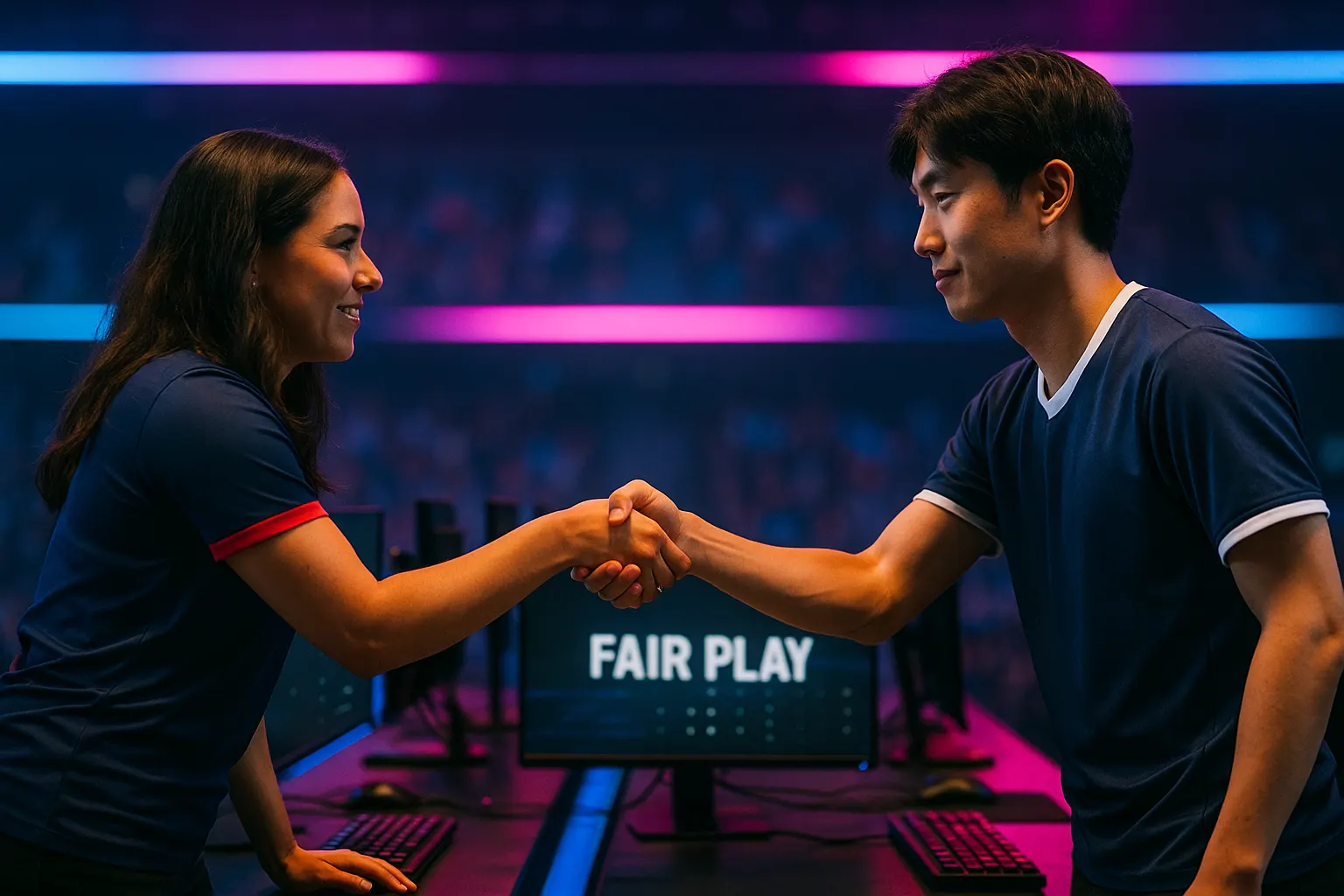
Fair play in esports depends on two things at once: rules that are verified, and players who are ready for the pressure they compete under. Cycling esports has built some of the strictest equipment checks in any digital sport. The rest of esports relies on a patchwork of publishers, leagues and an independent integrity body. Rules catch cheating after it happens. Readiness is the part teams can look at before a player under strain makes a bad call.
How does cycling esports stop digital doping?
It verifies the rider, the data and the hardware. In cycling esports, "digital doping" means faking the numbers that move a rider's avatar, usually power output or body weight. The UCI has sanctioned a Cycling Esports World Championships since December 2020, and the 2026 edition runs on MyWhoosh, with the Grand Final on 5 December.
The rules for reaching that start line are specific. Every rider has to pass MyWhoosh's independent verification process, which includes a validated Power Passport test and a verified weigh-in. Riders need approved equipment and dual power recording: a primary smart trainer or smart bike plus a separate crank or pedal power meter, so one source can be checked against the other. They also need a chest-strap heart-rate sensor. Checks happen before, during and after every race, and the Final is raced on ELITE's verified hardware, so every finalist rides the same equipment.
Those checks exist because riders have tried to beat them. In November 2022, South African racer Eddy Hoole won a Zwift continental qualifying race that gave him an automatic place at the 2023 UCI Esports World Championships. Zwift's data analysts found he had manipulated his power data. Cycling South Africa said the file showed a 25% higher power reading than his actual output. Zwift banned him for six months for bringing the sport into disrepute, and Cycling South Africa suspended his racing licence across all disciplines while it ran its own process with the UCI.
Why is fairness harder in the rest of esports?
No single body owns the rules. Cycling esports has one federation, one official platform and one race format. Most esports titles belong to a publisher, are played in leagues run by tournament organizers, and are policed by a mix of publisher anti-cheat software, league rulebooks and, for many events, the Esports Integrity Commission (ESIC).
ESIC's recent decisions show the range of what integrity work covers in 2026:
| Case | What ESIC found | Sanction |
|---|---|---|
| Dota 2, Esports World Cup 2026 | One player was party to an effort to lose a series 0-2; a second failed to report what he knew | Lifetime ban; five-year ban |
| eBasketball, March 2026 match | A player deliberately underperformed, backed by gameplay evidence and coordinated in-play betting | Five-year ban |
In the Dota 2 case, ESIC said that failing to report corrupt information is itself a serious integrity breach. In the eBasketball case, the finding rested on repeated in-game decisions, without proof that the player placed a bet or received a payment. Integrity rules in esports now reach past software hacks to choices made inside a match.
The gap shows up between titles. A rider at the cycling worlds clears the same checks as every other finalist. A player in another game faces whatever that publisher's anti-cheat and that organizer's rulebook require, and those differ from one title and one league to the next.
What does pressure have to do with cheating?
Pressure that goes unseen tends to come out as bad decisions, and cheating is one of them. Esports players compete for prize money, contracts and sponsors, often in front of a live audience and a chat that never stops. When a qualifying spot or a salary rides on one result, a shortcut can start to look reasonable to someone who is exhausted, isolated or afraid of losing their place.
The pressure does not stop once a player cheats. A player who has faked data or agreed to throw a match now carries the fear of getting caught on top of everything else, and the cases above show that investigators look back months. Each decision after that one gets harder.
Far more bad decisions under pressure look like a missed rotation, a tilted round, a fight taken when the call was to wait. The same strain that leads one player to cut a corner leads many more to play below their level. Fatigue and loss of focus cost teams results long before they cost anyone a ban.
How can teams look at readiness the way they look at practice load?
Make it routine, private and short. Esports teams already log scrim hours, review demos and watch reaction times. A short look at how ready each player is, taken several times a week, fits the same rhythm:
- Check in often. A few times a week shows a trend across a split, which a single conversation before playoffs cannot.
- Compare each player with their own normal. A change from a player's usual is what matters, whatever their usual looks like.
- Keep individual answers with the player. Players stop giving honest answers if they think a coach or a manager reads them.
- Know the next step. Every player should know who on staff, or outside the team, they can talk to when a week goes badly.
- Treat readiness like workload. If the trend drops, the response is a lighter schedule or a conversation.
None of this replaces anti-cheat software, verified hardware or an integrity body. It works on the other side of the problem: the player, before the decision.
Okaya is one way to build that habit for adult players. It is a short, private check-in for adults 18 and over. You talk with Sanora, Okaya's AI guide, for about 3 minutes. It compares how you sound, what you say and how your expression moves today with your own earlier check-ins. It uses points from your face, not a video of you. Individual results stay private to the individual. Many esports competitors are under 18, and Okaya is not for them.
Key points
- Cycling esports verifies riders, data and hardware: a Power Passport test, a verified weigh-in, dual power recording and, at the 2026 Final, identical verified equipment.
- Riders have still tried to fake their data, as the 2022 Hoole case showed.
- The rest of esports splits enforcement across publishers, leagues and ESIC, whose 2026 decisions covered match fixing, failure to report and deliberate underperformance.
- Pressure that goes unseen shows up as bad decisions, from a lost round to cheating.
- Teams can look at readiness as routinely as practice load, with individual results kept by the player.
Where should an esports team start?
Start with the schedule you already keep. Put readiness next to scrim hours and travel on the weekly plan, ask each adult player how ready they feel more than once before a big event, and make sure every player knows who they can talk to without it reaching the roster sheet. Rules and verification protect the competition. Paying attention to readiness protects the players inside it.
For a short, private readiness check-in built for adults, see Okaya.