Who Checks In on the Clinicians?
In short
In the APA's 2025 Practitioner Pulse survey, 34% of 1,742 psychologists said they felt burned out, and 51% of early career practitioners did. Supervision and consultation teams catch what clinicians bring to them. A short private check-in gives each clinician their own read every week and gives the owner a team trend, never one person's results.
In December 2025 the American Psychological Association published its 2025 Practitioner Pulse survey. One number in it should stop any clinic owner: 34% of 1,742 practicing psychologists said they felt burned out.
The split by career stage matters even more. Among early career practitioners, within 10 years of their doctorate, 51% said they felt burned out, against 16% of those at the most advanced stage. Early career clinicians are often the ones a practice has just hired and trained.
Two limits on those numbers. The survey covers licensed doctoral psychologists, not the social workers and counselors who make up much of a clinic's team, and only 6.6% of those invited answered. And it measures how people feel, not whether they leave.
Doesn't supervision already cover this?
Partly, and it matters. Most practices have supervision. In DBT, the weekly consultation team exists in part to treat the therapist. Many clinicians have their own therapist.
All of those catch what a clinician brings to them. They meet weekly at best, and they depend on the clinician saying it out loud. In the practices we talk to, the first clear signal that someone is running low is sometimes a resignation. A private check-in adds something in between: a regular read the clinician keeps for themselves, and a team view the owner can act on.
What does it cost when a clinician leaves?
Nobody has a good number. We looked for a peer-reviewed cost of replacing a behavioral health clinician and didn't find one. The dollar figures that circulate online trace back to vendors or to estimates with no study behind them, so we won't repeat them.
What a clinic owner can count is their own: the sessions the practice can't hold while a seat is empty, then hiring, training, and the referrals that go elsewhere in the meantime. The calculator on our clinics page lets you put in your practice's numbers.
What can an owner see without watching anyone?
Clinicians are right to be wary here. A clinician who thinks their answers will reach their boss will tell the tool what the boss wants to hear, and many owners are also the supervisor.
So the check-in is built for the clinician first. Each clinician has a short, private check-in: about 3 minutes talking with Sanora, Okaya's AI guide. Okaya compares how they sound, what they say and how their expression moves today with their own earlier check-ins. What the clinician sees is that comparison with their own past, not a burnout score or a clinical measure.
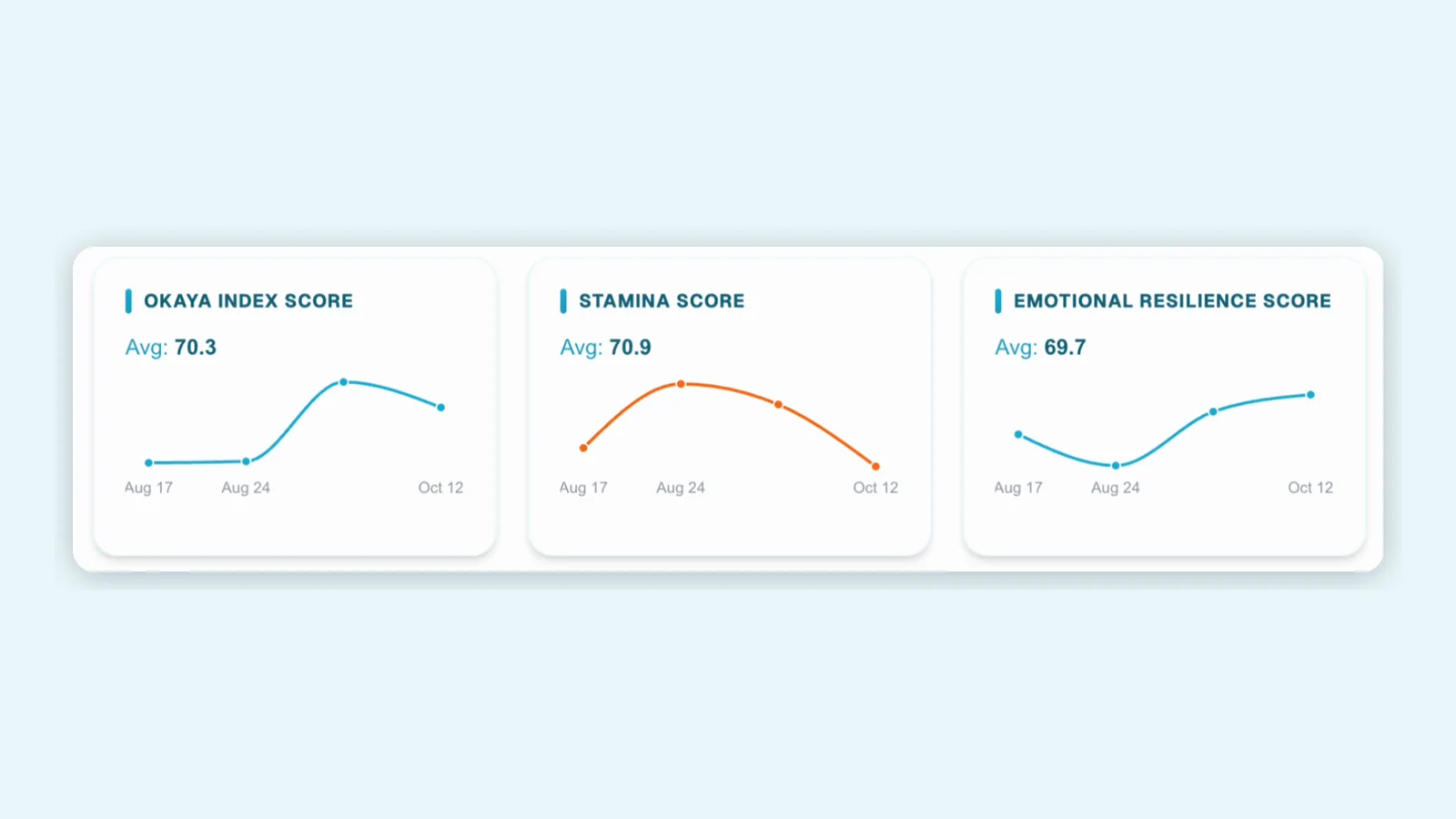
You see the team trend for readiness, stamina and emotional resilience, week by week. You see the team trend only, and only when the minimum number of people are in your group. Never one clinician's results or starter answers. It is never used for staffing, discipline or fitness-for-duty decisions, and it sits apart from supervision. The video stays on the phone. The phone extracts the facial landmarks. The landmarks and the voice audio go to the server, where the analysis runs. Okaya never identifies anyone from their face.
A small practice still gets something. Each clinician has their own check-in, conversation starters and resources. The team trend appears only when the minimum number of people are in your group.
What does an owner do with a team trend?
After a hard week, a critical incident or a training, you send a conversation starter: a short topic each clinician talks through privately with Sanora at their next check-in. Starters are about how the clinician is doing. There's no reason to name a client in a check-in, and clinicians shouldn't. You see how the team comes through over time, never one person's answers.
When the trend dips, the levers are the owner's: caseload and acuity, documentation load, productivity targets, time off. In a small team, don't read the trend against one person's hard week.
Okaya doesn't diagnose anyone or tell the owner who is struggling. Not a medical device. It gives a practice something it usually doesn't have: a regular, private way for clinicians to check in, and a team trend the owner can act on.
If you run a practice and want to see it, the clinics page has a 30-day free trial for your team. And if you've found your own way to keep track of how your clinicians are doing, I'd like to hear it.