Your Week, In Your Own Words: What a Digital Diary Card Gives You
In short
A paper diary card is often filled in just before session, from memory. On your phone, you write it on the day, as much or as little as you want. At the end of the week your week is on one page, and you decide whether to bring it to session. It's your choice: paper still works, and you decide what to share.
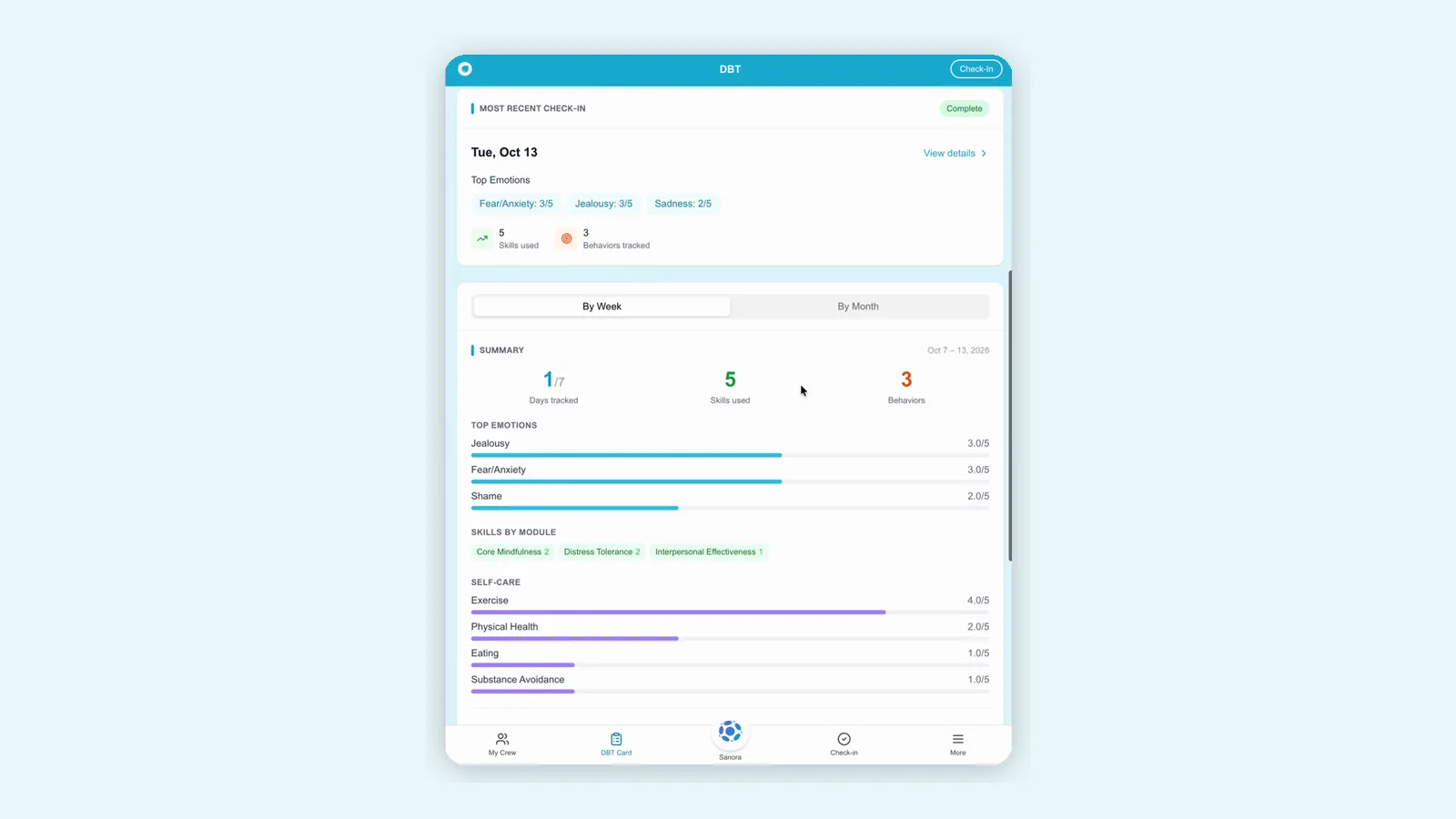
Most people who've kept a paper diary card know the routine. The card sits in a bag all week, and it gets filled in just before session, from memory. Tuesday blurs into Thursday. The hard moment from the weekend turns into a check mark, because there's no room and no time to say more.
That isn't a failing. A week is long, and memory edits it. What gets lost is usually the part that mattered most: what was going on, how it felt at the time, what you tried.
What changes when the card is on your phone?
You write it when it happens, or at the end of the day, wherever you are. The things you track with your therapist are already on the card, so you're not starting from a blank page. The open boxes take as much as you want to write, a word or a paragraph.
You can also do a short, private check-in with Sanora, Okaya's AI guide, when you choose.
What do you get out of it?
Your week, in your own words. Not a reconstruction the night before. What you wrote on the day stays as you wrote it.
Your own patterns. In your dashboard and calendar, you can look back over the weeks yourself: the days that went harder, what helped, what you reached for. You don't need anyone to point them out.
A head start on the hour. At the end of the week, Okaya builds a one-page summary. If you print it and bring it to session, or send it securely, the conversation can start from what you noticed instead of from what you can remember.
Who sees it?
You do. Your diary card, check-ins and weekly summary belong to you. Your therapist sees the weekly summary only when you bring it to session or send it securely. Your clinic sees how its program is used, in totals, never your card or check-ins.
Okaya is voluntary and sits outside treatment. It is not part of the clinical record. Okaya does not monitor you and does not alert your clinic, and it isn't a crisis service. If you rate a high urge, Okaya shows you your own safety plan and crisis lines, and your crisis plan with your therapist stays as it is. If you are in danger now, call 911, or call or text 988.
Is it for you?
It's your choice. Paper still works, and some people prefer it. If you choose the phone, you pay Okaya directly, never through your clinic: $5 a month while you're in your clinic's program, then $11.99 a month once you leave it. Okaya is for adults 18 and over. Your therapist can help you set it up in session, which is the easiest way to start.
If you want to see how it works first, the diary card page and our step-by-step guides walk through it.
And if you already keep a card, on paper or on your phone, I'd like to hear what works for you and what doesn't.